Search This Blog

Wednesday, September 29, 2010


Concept Cars Gone Bad
Sheet-metal creations that should never roll off a production line.
By Sam Foley of MSN Autos

EN-V Xiao concept from General Motors
We're in favor of creative experimentation, especially in the automotive world, where entrenched, sclerotic bureaucracies often create a culture that trends toward the formulaic when it comes to vehicle design. The design-by-committee philosophy often practiced in this staid system has produced cars as flavorless as the Cadillac Cimarron and as audaciously stupid as the Pontiac Aztek. But it's also produced many winners. While determining the success or failure of a vehicle is, as one can imagine, not an exact science, the creation of concept cars helps to determine what works and what, well, doesn't.

To show off their creative chops at car shows, automobile companies routinely set their design departments free to follow their creative instincts and prove an aesthetic point about an automaker's direction. We call their creations concept cars. The history of the concept car dates back to the late 1930s, when legendary General Motors designer Harley Earl created the Buick Y-Job, a gorgeous expression of one man's love for fenders. The Y-Job would influence Buick styling for years to come, and it also launched a polite competition of ideas among automakers that would result in concepts as outlandish as the 1958 Ford Nucleon — which, as the name suggests, was designed to be a nuclear-powered vehicle — and as iconic as the GM XP-755 Mako Shark.

Bing: GM Mako Shark

Neither the Nucleon or the Mako Shark were true success stories; i.e., both were never produced. But that doesn't mean they were failures either. Concepts let automakers test designs without taking a huge financial gamble on a full production car. For instance, the enormously popular Mako Shark might not have seen the lights of a showroom, but it directly influenced the design of the 1963 Corvette Sting Ray, a sheet-metal icon.

But for every concept that makes a big splash with the public, there are others that go horribly, horribly wrong. This article celebrates the latter, the concept cars destined to become future train wrecks. While all of the vehicles featured here were meant to show off a company's creative IQ, they in fact sent the auto-show-going public into paroxysms of disgust or fits of eyebrow-arching perplexity. Our role is not to chide the automakers' design teams for trying something new, only to let them know what their friends and colleagues probably won't — that the car they've worked so hard on is a failure. And that it's time to try something new.

Future Products: Toyota Lineup Gets an 18-Month Makeover
Posted by AutoWeek on Tuesday, September 28, 2010 9:35 AM


Toyota plans to move into new product segments over the next 18 months, as well as redesign several mainstream models.

By the spring of 2012, Toyota will launch all-new versions of the Camry, Yaris, Tacoma and RAV4. Also, the new FT-86 sport coupe, developed with Subaru, should arrive on these shores by that time. And in the wings are a plug-in version of the Prius and a Prius coupe.

Yaris: A redesign is scheduled for the 2012 model year. Japan may get a hybrid version, but the strong yen will prevent the hybrid from coming to the United States. Instead, expect a six-speed automatic transmission with short lower gears and tall upper gears to improve acceleration and fuel economy. A newly engineered 1.5-liter engine is probable, as the current one has been around for more than a decade. Forget rumors of a 1.8-liter engine. Unless Toyota significantly widens the engine bay, it won't fit.

Corolla: Toyota extended the Corolla's cadence to six years for its last redesign and, with all the engineering challenges the company faces, probably will do so again. That will make its 2012 model year restyling more extensive than a mere fascia change--more likely a reskin--and would push a redesign to spring 2014.

Matrix: The Canada-built five-door compact is based on the Corolla platform, so expect it to continue until the spring of 2014, when the Corolla is redesigned. But with the strong yen pushing Toyota to build more Corollas in North America--and with the Fremont, Calif., assembly plant now closed--the ratio of Corollas to Matrixes built in Cambridge, Ontario, is likely to swing away from the Matrix.

Camry: The Camry was being redesigned as Congress was setting stricter corporate average fuel economy standards, delaying development a few months. Expect the next Camry to arrive in late 2011 or early 2012 as a 2012 model, as opposed to the typical late-summer launch.

Toyota will maintain the Camry's current footprint, although it may be wider. The fascia will follow the styling of the Venza. There also may be updates to the V6.

Camry Solara: It's dead.

Prius: A plug-in version is expected in the 2012 model year. Current prototypes have a 14-mile battery-only range, but that may be extended with a larger battery pack. The prototypes also have a lithium ion battery pack, which may be added as part of a 2013 model year midcycle change and give the hybrid 50 mpg in the combined city/highway cycle.
A full redesign slated for the 2015 model year will have the lithium pack. A decontented version code-named "Package Zero"--meant to undercut Honda's Insight--is planned once U.S. production starts.

Prius coupe: Using Prius underpinnings but with more dramatic styling, the coupe would be built at Toyota's new plant in Mississippi. It's meant to be a Honda CR-Z competitor. Toyota already has conducted a design competition involving the company's four global design studios and a couple of outside coachbuilders. The global vehicle could be built in Japan in 2012 as a 2013 model.

Prius pickup: The A-BAT concept could see action as both a Toyota and a Scion. The Toyota version will be based on the Prius, making it more of a parcel carrier than a cargo hauler. The big obstacle: It must be built in the United States because of the "chicken tax" on imported pickups. Toyota also plans a Prius wagon, but it will not come to America.

Avalon: A thorough midcycle freshening this past spring has pushed back the redesign to mid-2013 as a 2014 model. The Avalon preceded the Camry during the last model change-over but will follow in the upcoming redesign. So the Avalon is on a stretched cycle--perhaps seven years long. Toyota is wrestling with what to do with the segment. The vehicle could go sporty like the Nissan Maxima rather than plush like a Buick.

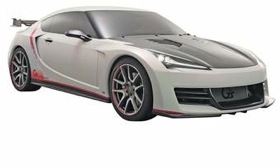
FT-86: The on-again, off-again sporty coupe, developed with Subaru, was shown in concept form at the 2009 Tokyo auto show. Styling of the 2009 show car was conservative, so Toyota subsidiary Gazoo Racing sharpened it up at the 2010 Tokyo Auto Salon in January.

The FT-86 engine is rumored to be a 2.0-liter, turbocharged, 200-hp boxer-four borrowed from Subaru, while Subaru will get a higher-performance--and higher-priced--version. Toyota gets rear-wheel drive, while the Subaru is equipped with all-wheel drive. Toyota aims for a spring 2012 launch. Pricing is expected to be $25,000 to $30,000.

RAV4: The compact crossover will be redesigned for the 2012 model year. Having been thrashed by the new Honda CR-V, the next RAV4 is expected to get an upgraded interior and bolder design. A new 2.5-liter four-cylinder was introduced as part of the 2009 freshening, so don't expect major changes there.

But Toyota looks to be dumping the V6 and replacing it with a hybrid-four because of CAFE fears. Engineering simplification is another factor. It's easier to fit a hybrid pack in the engine bay than two more cylinders. Toyota and Tesla Motors are working on an electric version of the RAV4 that should debut in 2012.

Highlander: A freshening is planned for the 2011 model year, with a full redesign of the crossover for the 2013 model year if the vehicle stays on a five-year cadence. The Highlander has a high order rate on V6 engines, which makes for CAFE complications. Toyota wants a higher order rate for the hybrid over the V6 as few four-cylinder versions of the Highlander are sold.

Venza: No major changes are expected--although if the Camry V6 gets re-engineered, the Venza will get the same engine in 2012.

Sienna: The minivan was redesigned this year. Sales began in the spring.

FJ Cruiser: The FJ Cruiser, launched in the spring of 2006, is a one-generation vehicle. The strong yen creates a pricing problem for the Japan-built SUV. Expect a quiet sell-down in 2012.

4Runner: No major changes are expected.

Sequoia: A company source said Toyota considered moving the SUV to a passenger-car platform, but the current Tundra platform is inexpensive to build. So for the 2014 model year, expect the restyled and re-engineered Sequoia to remain on the Tundra platform and use even more component commonality. The current model is the same as the Tundra from the B-pillar forward. The 2014 version probably will share most of the Tundra CrewMax cabin structure.

Land Cruiser: No major changes are expected in the SUV for a few years.

Tacoma: A restyling and re-engineering of the small pickup is expected for the 2012 model year. The platform is linked with Prado, 4Runner and Hi-Lux in the rest of the world, with frames built in different widths for different markets.

Much of the styling seen in the 2010 4Runner will carry over to the Tacoma. A plan that the Tacoma would share Tundra component sets has been scratched because the beefier Tundra parts would cost too much on a compact-pickup budget. Expect model variants to decline on the new model.

Tundra: No major changes are expected until the 2014 model year redesign, although the regular cab gets a long bed in 4x2 trim this year. The next Tundra will evolve from the current platform, with more money put into the interior styling. At its reduced volume, Toyota doesn't need two V8 engines, so expect maybe one V8 that splits the difference between the current 4.6-liter and the 5.7-liter.

Sunday, September 26, 2010

Nissan's Infiniti to market all-electric luxury vehicle in 2013.


Infiniti plans to launch its first luxury all-electric vehicle in the United States and other global markets in 2013.

Nissan Motor Co.'s luxury division said today the Infiniti EV will be “a stylish, high performance five-seat luxury vehicle with zero emissions technology.”

Infiniti first announced plans to market an all-electric vehicle last year but offered few details until now. It will be based on the same platform as the Nissan Leaf, an-electric car scheduled to go on sale later this year.

"This future EV will play a major part of Infiniti's 'eco performance' strategy that will see a greater focus on hybrid and EV technology," Infiniti Vice President Ben Poore said in a statement. "We are committed to applying the world's best technologies to reduce emissions without sacrificing driving excitement or engagement.”

Nissan – under CEO Carlos Ghosn - is spending $5 billion through 2010 to become a leader in EV sales worldwide.

Infiniti will unveil the 2012 M35 hybrid sedan in November at the Greater Los Angeles auto show. The M hybrid is based on the M sedan and will deliver V-8 performance with 4-cylinder fuel economy from an estimated 302-horsepower, 3.5-liter V-6 engine and a 50 kilowatt electric motor with estimated horsepower of 67, Infiniti said.

The Infiniti M35h is scheduled to go on sale in spring 2011.


Read more: http://www.autonews.com/apps/pbcs.dll/article?AID=/20100924/OEM/100929888/1280#ixzz10eB19yac

Friday, September 24, 2010

Ferrari SA Aptera pays homage to Pininfarina


Ferrari has unveiled the 599 roadster -- called the SA Aperta -- that it will present at the Paris auto show next week.

Eighty SA Apertas will be built -- and are all sold already. Ferrari decided to do 80 cars to celebrate Pininfarina's 80th anniversary, while the SA pays homage to Sergio and Andrea Pininfarina, whose company has designed several Ferraris over the years.

There is a top, but Ferrari says it's "a light soft top designed to be resorted to only if the weather gets particularly bad."

While full specifications will be announced in Paris, it is known that the car is powered by a front-mounted V12 from the 599, producing 661 hp. Roll bars integrated into the rear are designed to protect in a rollover.

Ferrari claims the chassis is as stiff as the 599 Coupe. The price hasn't been announced but the sale price is expected to be about $500,000.

Read more: http://www.autonews.com/apps/pbcs.dll/article?AID=/20100924/OEM04/100929916/1130#ixzz10T4wL8WU

Tuesday, September 21, 2010

Ferrari recalls supercars after fires


MILAN (Reuters) -- Ferrari said it is recalling more than 1,240 of its 458 Italia supercars to replace an adhesive prone to melting after five reports of fire accidents.

Ferrari launched an investigation last month after media reports of fire accidents involving five vehicles in California, Paris, Switzerland, China and one other unnamed location.

A company spokesman said the problem was related to an adhesive used in the wheel-arch assemblies that in certain circumstances due to overheating can melt and eventually ignite.

As a result, Ferrari, owned by Italy's carmaker Fiat, will be asking the owners of 1,248 cars produced before July 2010 to bring them in to have the glue replaced with mechanical fasteners, the spokesman said.

Those owners who had their cars damaged by fire will receive a new model, the spokesman said.

The 458 Italia replaced the F430, Ferrari's best-selling model. In Italy, the 570-hp 4.5-liter V-8 458 Italia starts at 197,000 euros ($253,000).

In addition to sending a letter to the 458 Italia owners, Ferrari dealers are calling the customers individually to inform them of the recall. It takes about a half day to repair the problem at a dealership, the company said.

Read more: http://www.autonews.com/apps/pbcs.dll/article?AID=/20100902/ANE/309029993#ixzz10BOlstlO

Porsche 911 Speedster returns


Porsche is bringing back the 911 Speedster some 16 years and three model generations after it last was featured in the German sports-car maker's lineup.

The car, pictured here ahead of a planned unveiling alongside the 911 Carrera GTS at the Paris motor show, is just the third 911 Speedster to be put into series production and follows tradition by being based on the existing cabriolet version of Porsche's iconic rear-engine sports car.

Paying homage to the car that kicked off Porsche's fascination with the chopped-top look, the original 356 Speedster launched in 1953 at the behest of its U.S. importer. The new 911 Speedster uses standard bodywork but receives a shorter and more heavily raked windscreen than other 911 models.

A plastic tonneau cover behind the cabin also receives a double-bubble treatment reminiscent of that gracing the first 911 Speedster, the 964 model introduced in 1988. The overall appearance is further enhanced by the adoption of the widened rear bodywork of the latest 911 Carrera 4S cabriolet, with its 1.7-inch wider wheel housings.

A flat, manually operated fabric hood is designed to provide occasional protection from the elements, although as on earlier examples of the 911 Speedster, it is unlikely to be as sturdy as the standard 911 Cabriolet's automatic roof.

25th anniversary

The car was created to celebrate the 25th anniversary of Porsche Exclusive, the company's in-house individualization program. Porsche's latest 911 also receives a series of visual upgrades, including an additional chin spoiler at the base of the front bumper, tinted indicator lamps, blackened headlamps surrounds and windscreen frame, unique side sills and a rear bumper boasting 911 GT3-style air ducts behind the rear wheel arches.

Inside, there is a combination of black leather and color-keyed elements from the Porsche Exclusive catalogue.

Power for the rear-wheel-drive 911 Speedster comes from the same 3.8-liter version of Porsche's classic horizontally opposed six-cylinder engine as that unveiled in the 911 Carrera GTS. With 402 hp, it packs 22 hp more than the standard 3.8-liter flat-six used in the 911 Carrera S cabriolet.

Similar specs

Torque remains the same at 310 lb-ft, albeit developed 200 rpm lower in the rev range at 4,200 rpm. No performance figures have been released, but expect 0 to 62 mph in about 4.5 seconds and a top speed of 190 mph.

Standard equipment includes Porsche's excellent seven-speed PDK dual-clutch gearbox, a locking differential, adaptive damping and carbon-ceramic brakes.

In a move that will ensure its exclusivity, Porsche says it plans to produce just 356 examples of the new 911 Speedster. North American pricing is yet to be revealed but look for the car to sticker at about $150,000.

Read more: http://www.autonews.com/apps/pbcs.dll/article?AID=/20100921/OEM04/100929982/1130#ixzz10BNPbQmB